

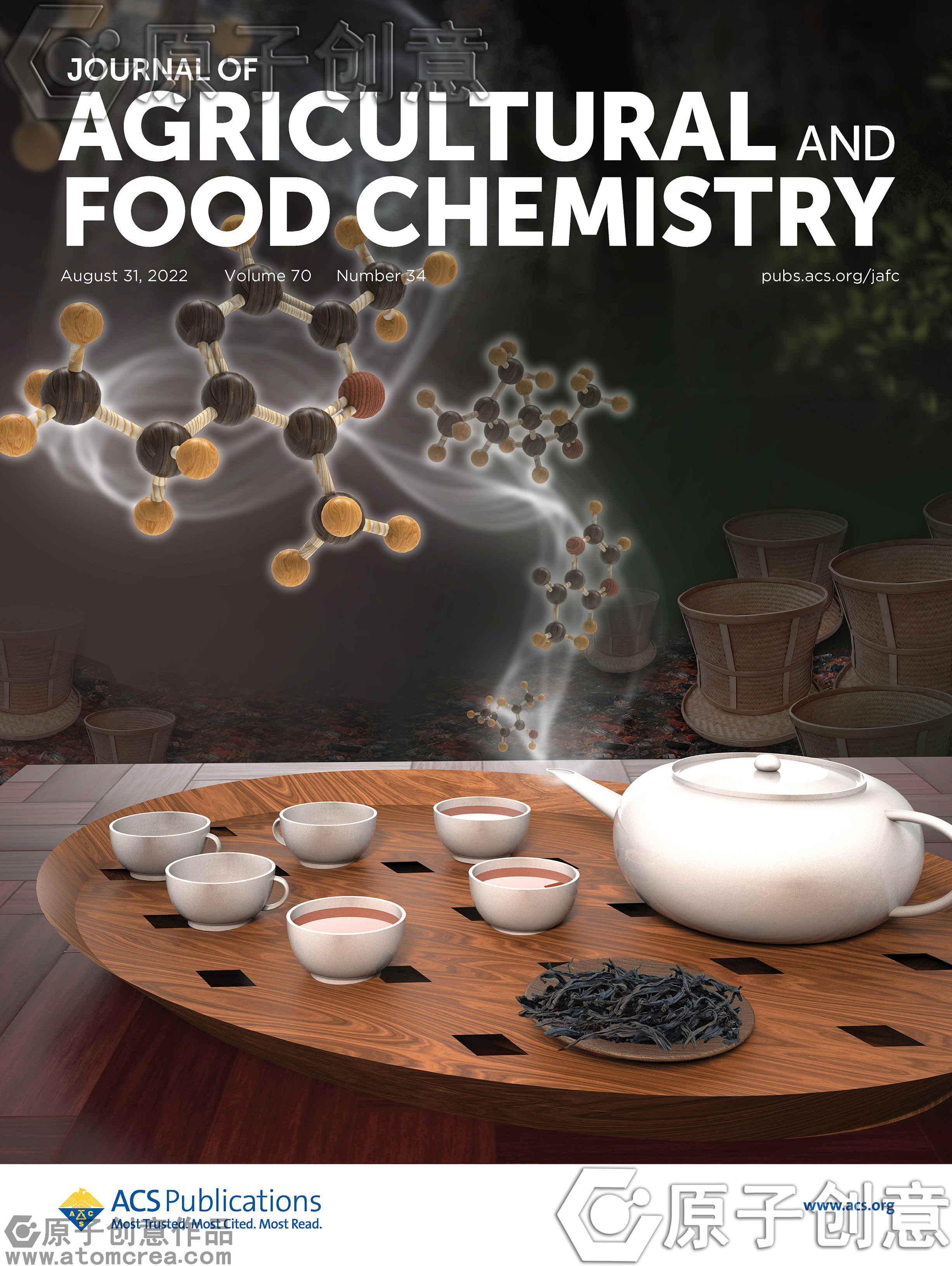
Decoding the Specific Roasty Aroma Wuyi Rock Tea (Camellia sinensis: Dahongpao) by the Sensomics Approach
Aroma extract dilution analysis was performed on volatile fractions extracted from a freshly prepared Dahongpao (DHP) tea infusion using solvent-assisted flavor evaporation, yielding 65 odor-active domains with flavor dilution factors ranging between 32 and 32,768. In addition, six aromatic substances were captured by headspace analysis. Quantitation of 54 compounds by an internal standard method and stable isotope dilution assays revealed that the concentrations of 32 odorants exceeded their respective orthonasal odor threshold values in tea infusion. The results of odor activity values (OAVs) suggested that 2-metylbutanal (malty) and γ-hexalactone (coconut-like) had the highest OAVs (248 and 154). Eight odorants including γ-hexalactone (OAV 154), methyl 2-methylbutanoate (59), phenylacetic acid (7.2), acetylpyrazine (5.7), 2-methoxyphenol (3.4), p-cresol (2.7), 2,6-diethylpyrazine (2.7), and vanillin (1.8) were newly identified as key odorants in DHP tea infusion. An aroma recombination model in a non-volatile matrix extracted from tea infusion satisfactorily mimicked the overall aroma of DHP tea infusion, thereby confirming the identification and quantitative experiments. Omission experiments verified the obvious significance of 6-methyl-5-hepten-2-one (OAV 91), 2-ethyl-3,5-dimethylpyrazine (19), 4-hydroxy-2,5-dimethylfuran-3(2H)-one (13), and acetylpyrazine (5.7) as key odorants for the special roasty and caramel-like aroma of DHP tea.







暂无评论内容